
Costing a Maintenance Shutdown Before You Book It
Every farm eventually has to stop. A transformer service, a switchgear inspection, a cooling loop flush: the work is necessary, the date is negotiable, and the cost of the stop is rarely written down. At 1 PH/s, two days offline forgoes 0.00089721 BTC, which is $75.99 at $84,692 per BTC. Put that number next to the quote for the work and the scheduling decision becomes arithmetic instead of instinct.

Key takeaways
- 48 hours at 1 PH/s costs 0.00089721 BTC, or $75.99 at the 21 Sept 2026 price.
- Each hour of a stop is 0.00001869 BTC per petahash, so a shorter work package has a directly proportional saving.
- Schedule around difficulty adjustments and power price peaks, not around staff convenience alone.
- Hosted contracts differ on whether planned stops are billed, so read that clause before choosing a date.
A stop is a cost with a date attached
Unplanned failures are unpredictable and therefore hard to budget. Planned work is the opposite: the duration is known within a few hours, the date can usually move by a week or two, and the output forgone can be calculated in advance. That combination makes a shutdown one of the few costs in mining that can be genuinely optimised rather than merely absorbed.
The calculation has three parts. How many hours will the site be off? What is the hashrate that would otherwise be running? And what is the credit per hour at current difficulty? Multiply and you have the cost of the stop in BTC, then convert at the price you expect to sell at. The third input is the only one that is a guess, and it is also the smallest source of error over a two-day window.
What two days of output looks like
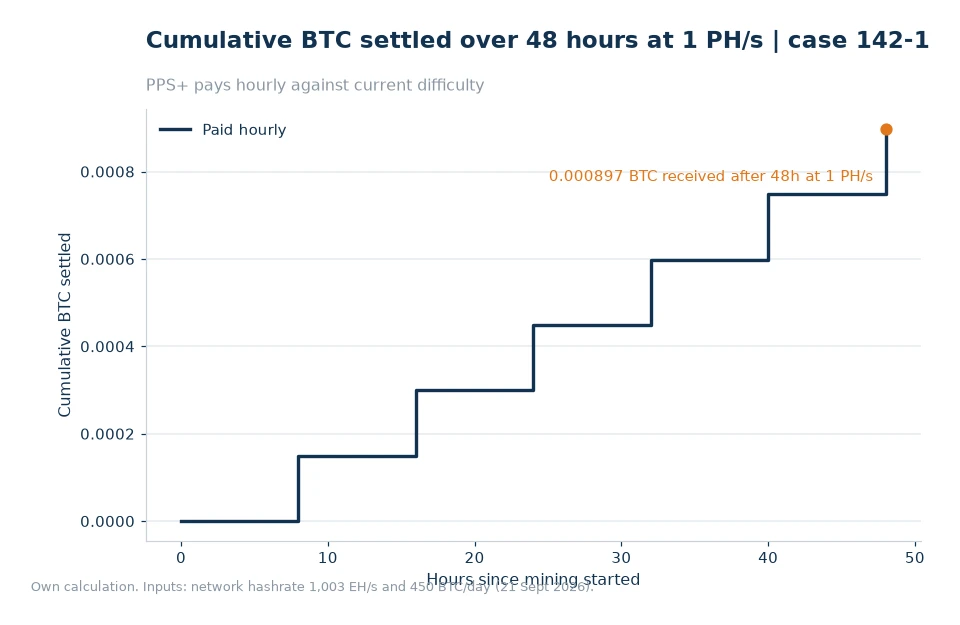
Under PPS+, the credit accrues hourly against current difficulty, so a stop removes a whole number of steps from the series. Two days is 48 steps. On a petahash each step is 0.00001869 BTC, which gives 0.00089721 BTC at the end of the second day. The loss is not spread over a month or averaged with better weeks; it is simply 48 steps that never appear.
That framing helps with sequencing. If the work can be split into two twelve-hour blocks on consecutive weekends, the total downtime is 24 hours rather than 48, and the cost halves to 0.00044861 BTC. Splitting is not always possible, because some jobs require the bus to be dead for the whole duration, but it is worth asking the contractor whether the work package has a natural break.
Choosing the window
Three calendar inputs should influence the date. The first is the difficulty adjustment, which happens roughly every two weeks: if an adjustment is due and the estimate points downward, waiting a few days means the same shares are worth slightly more, so the forgone credit is slightly smaller. That is a marginal effect on a two-day stop, but it costs nothing to check the current figure on the pool state page before the date is fixed.
Ask the network operator as well as the contractor. Some regions publish planned substation work weeks ahead, and a site that coordinates with those dates avoids the double cost of losing output and then losing it again when the utility cuts power without notice. If the local grid has a summer peak that brings voltage dips, the maintenance window is also a good moment to check whether the machines' power supplies are set to ride through them.
The second is the power contract. If the site pays a demand charge or a time-of-use rate, a stop that straddles a peak period can reduce the bill at the same time as it reduces output, which changes the net cost of the work. The third is the weather: scheduling cooling maintenance in the mildest week of the month reduces the risk that the restart happens during a heat event with the plant half commissioned. None of these considerations is exotic, and together they often save more than the work itself costs.
Who pays for the hours
If the machines are in a hosted slot, the answer depends on the contract. Some agreements bill a fixed monthly fee regardless of uptime, which means a planned stop costs you the output and the fee. Others suspend the fee for verified downtime. A few treat planned maintenance as the miner's risk and unplanned outages as the host's, with an uptime credit that only applies in the second case.
Read that clause before agreeing a date, and get the answer in writing. The ViaBTC Mining Farms listing is the natural place to compare hosting options, and the difference between two quotes often sits precisely in this clause rather than in the headline rate per kilowatt-hour. A host that suspends fees for a scheduled stop is effectively sharing the cost of the work; one that does not is charging you twice.
| Work package | Hours offline | BTC forgone | USD forgone |
|---|---|---|---|
| Fan wall replacement | 6 | 0.00011215 | $9.50 |
| Cooling loop flush | 24 | 0.00044861 | $37.99 |
| Transformer service | 48 | 0.00089721 | $75.99 |
| Switchgear overhaul | 72 | 0.00134582 | $113.98 |
Use the table as a negotiation aid. When a contractor quotes a four-day window for a job that the previous contractor finished in two, the extra two days now has a price: $75.99 per petahash at the read-date price. Multiply by your actual hashrate and the difference between two quotes is rarely as close as the invoices suggest.
Worked example
Take the transformer service and build the number from the network data.
- Chain output per TH/s per day: 450 ÷ 1,003,000,000 = 0.00000044865 BTC.
- At 1,000 TH/s: 0.00044861 BTC per day.
- Per hour: 0.00044861 ÷ 24 = 0.000018692 BTC.
- Two days is 48 hours: 48 × 0.000018692 = 0.00089721 BTC.
- Convert: 0.00089721 × 84,692 = $75.99.
- If the site runs 5 PH/s rather than 1, multiply by five: 0.00448605 BTC, or $379.96.
- If the work is split into two 12-hour blocks, the loss is 24 × 0.000018692 = 0.00044861 BTC, or $37.99 — a saving of exactly half.
The last line is the one to bring to the scheduling meeting. Splitting a job is often possible for electrical work that can be isolated by bus section, and the saving is large enough to justify asking.
Frequently asked questions
How do I price a planned outage at my hashrate?
Multiply hours offline by 0.00001869 BTC per petahash per hour, then scale to your hashrate. Two days at 1 PH/s is 0.00089721 BTC, about $75.99.
Is it better to stop everything at once or in stages?
Stages usually cost less. Two 12-hour blocks total 24 hours and 0.00044861 BTC at 1 PH/s, half the cost of a single 48-hour stop.
Does a host charge during planned maintenance?
It depends on the contract. Some suspend the fee for verified downtime, others bill regardless, so confirm the clause in writing before fixing the date.
Put the number in the work order
Before the purchase order goes out, add a line for forgone output: hours offline, hashrate affected, BTC cost at current difficulty and the dollar value at the price you use for planning. That single line changes how the job is scoped, because it gives the contractor an incentive to finish early and gives you a reason to ask whether the second shift is worth paying for.
Then diarise the restart check. When the site comes back, confirm the hashrate returns to its previous level rather than to ninety-something percent of it, and watch the first few hourly steps in the account. A restart that leaves one rack misconfigured is a slow leak, and it is easiest to catch in the first hour. The Profit Calculator gives you the daily figure to compare against, so a shortfall after the work is obvious rather than something you discover at the end of the quarter.
Sources: ViaBTC farms listing and fee page for hosting terms and the listed 4% on the PPS-settled block reward[1]. Chain inputs on 21 Sept 2026: 132.76 T difficulty, 1,003 EH/s network hashrate, 3.125 BTC subsidy per block, 144 blocks a day, BTC $84,692. Text published 24 Oct 2026, all figures read 21 Sept 2026.